

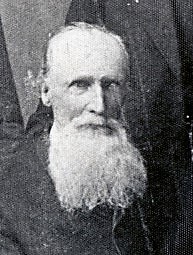
Our family has a treasured token: a white silk handkerchief carried by an ancestor during his service in the Civil War. It’s been passed tenderly from generation to generation of women in our family. In medieval times, a lady’s favor was usually something small that could be tucked away in the knight’s armor as a private symbol of devotion. Much like a medieval knight, Great-Great-Great Grandfather George Nazro Esler carried his lady’s favor, a white silk handkerchief, into war with him and it survives to this day.
Civil War Veteran George Nazro Esler was born on 18 March 1832 in the town of Camillus, New York. George was the baby of the family; the ninth and last child born to Henry Esler and Abigail Hunt Esler, a Quaker woman. He was also only one of two boys in the family, with seven sisters!
The family steadily moved west during George’s childhood. The Eslers appear in the 1850 Census, living in the town of Rubicon, Dodge County, WI. Their occupations were listed as farmers and George is shown as 18 years old.
By 1860, George and his older brother Henry were living in Springville, Bad Ax County (now Vernon County), Wisconsin. Shortly thereafter, both men enlisted in the Civil War. George enlisted on 21 February 1862 as a Private in the Wisconsin 18th Infantry Regiment, Company D, the first time he enlisted in the war. Brother Henry J. Esler enlisted in the Company H, Wisconsin 16th Volunteer Infantry. Both men fought on the side of the Union.
George had a varied military experience which included multiple enlistments. He successfully fought at the bloody Battle of Shiloh, Tennessee in April 1862, where 23,000 died or were wounded. His regiment went on to the battle of Corinth, Mississippi, where he was shot in the hip and wounded on 3 October 1862. George was discharged on 4 February 1863 and he returned home to Springville, Wisconsin, having survived the war.
Throughout the Civil War, George carried a white silk handkerchief, possibly given to him by his betrothed, a Miss Rosetta Seville Haney. George and Rosetta were married on 20 September 1863, just a few months after his discharge. George was 31 years old and Rosetta was a youthful 18 years. Rosetta probably tucked George’s silk Civil War handkerchief safely away, grateful he survived the war and returned safely back home to her.
Patriotism, or perhaps adventure, must have called or maybe George needed money to support his growing family, but in 1865, he re-enlisted as a Sergeant with the Wisconsin 44th Infantry, Company G. He served a one-year term and returned safely home after his enlistment period ended. By that time, the Civil War had ended and George Nazro Esler was 33 years old, although his discharge papers say he was 38.
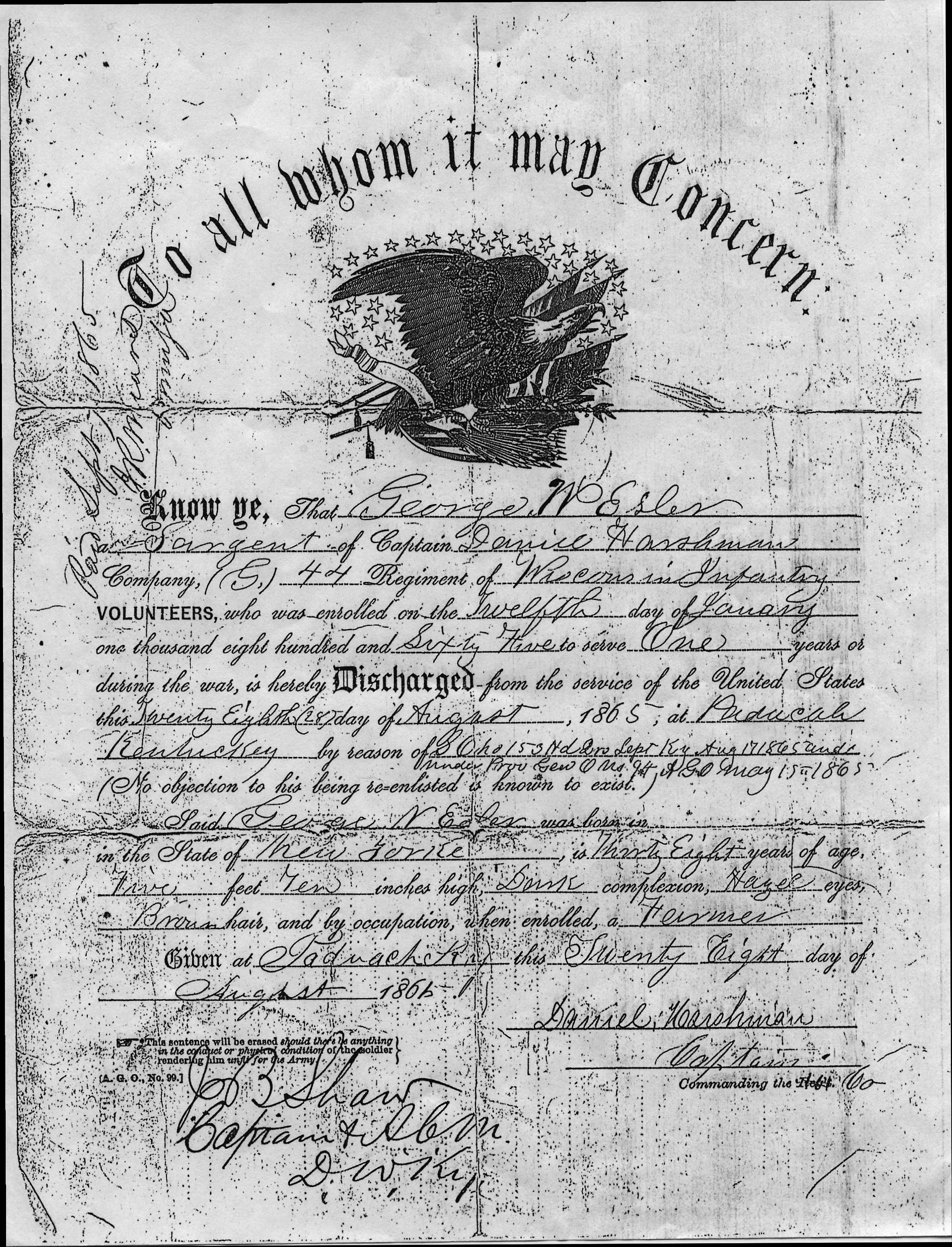
After the war ended, George and Rosetta made their home in the town of Harmony, Rock County, Wisconsin, but by 1870 the family had relocated to Houston, MN where they lived with their three children, Mary (6 years), Florence (4 years), and Jesse (2 years). Also living in the household was George’s mother Abigail (age 89) and his older brother Henry (age 45), who had been taken prisoner in the Civil War, in August 1864. Henry was confined to the notorious Andersonville Prison until the close of the war, when he was released in 1865.
The 1880 Census shows the family living in Blue Hill Township, Sherburne County, MN, and by 1900, George, his wife Rosetta, and four of their children (Charles, Emaline, Frederic, and Clara) were living in St. Louis Park, Minnesota.
George’s oldest daughter Mary, our ancestor who was born in 1864, was married by this time and was also living in the Village of St. Louis Park with her own family. Mary eventually had seven children, including my great-grandmother Lillian, whom we knew as Nana. Nana’s younger sister was Rosetta, so named, no doubt, after their Grandmother Rosetta, George’s wife.

In 1904, Great-Aunt Rosetta, at the age of about 14 years, came to be in possession of her Grandpa George’s white silk Civil War hanky. She treasured this keepsake for years, eventually giving the heirloom to her young grand-niece Janice Mae Burton in 1950. Janice was the grand-daughter of Rosetta’s sister Lillian (Nana).
Rosetta’s niece Janice is my Aunt Jan, my father’s youngest and only sister. She was the perfect recipient for such a gift. Aunt Jan carefully kept the precious silk handkerchief safely tucked away for over 70 years, and she recently honored me with the gift of this family heirloom. I’m so grateful for this piece of our family’s history. I estimate the handkerchief is more than 160 years old and is very fragile. It’s made of soft white silk, gently yellowed from age. Curiously, Great-Aunt Rose wrote on the handkerchief in ink, to commemorate the historical importance of her gift.
May 1950 ~ Geo. N. Esler, Grandfather of Nana and Aunt Rose, carried this through the Civil War. He gave this to Aunt Rose in 1904, and I give it to you Janice, with love from Aunt Rose.
Hand written on the silk handkerchief in ink.
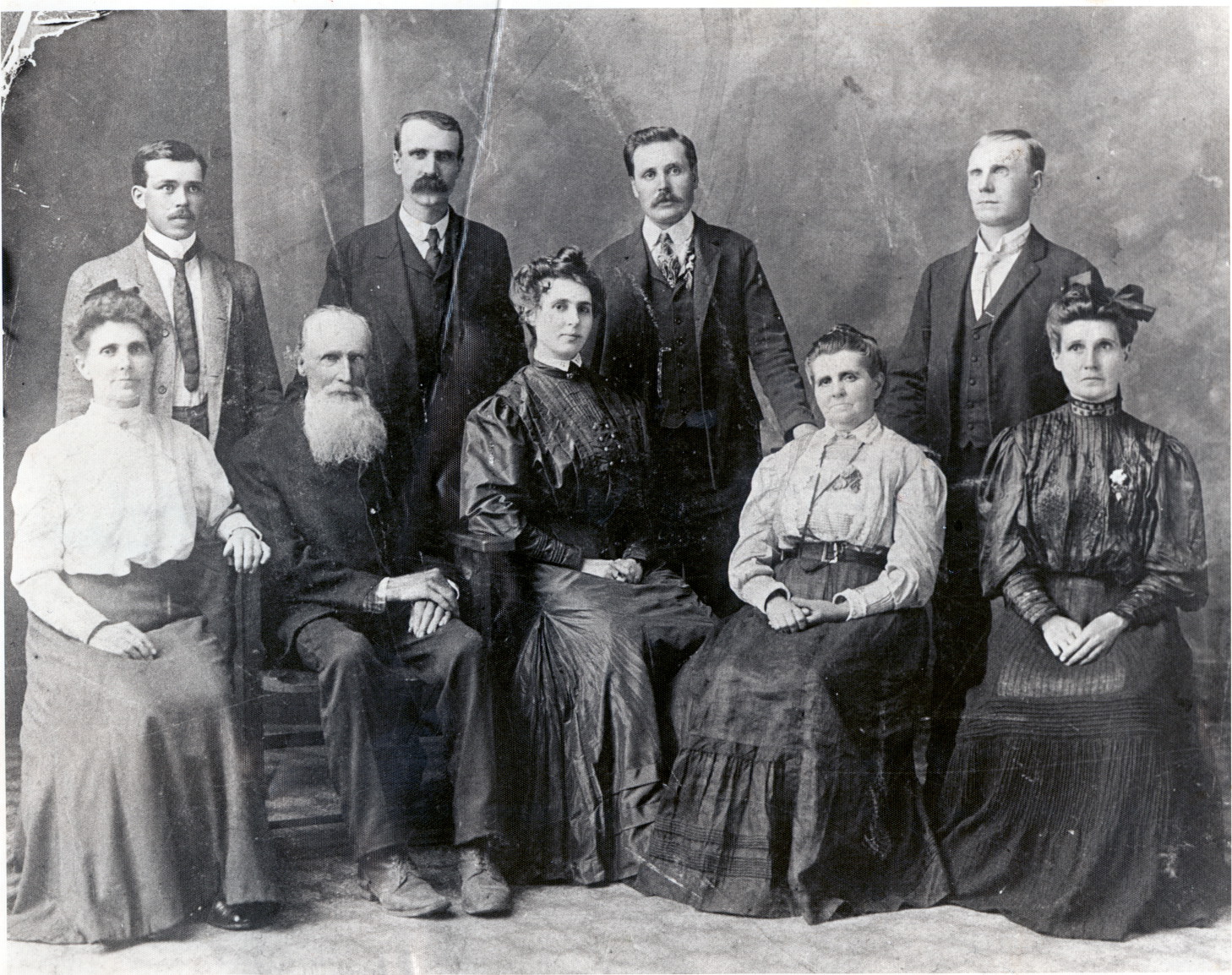
By 1910, George Nazro Esler and his wife settled in Ogilvie, Kanabec County, Minnesota, where he lived out the rest of his days. He passed away from natural causes on 19 December 1911, just shy of his 80th birthday and is buried at Graceland Cemetery in Ogilvie, MN. His widow Rosetta, also known as Rosa, lived with her children until her passing on 19 May 1924 at age 79 from old age.

 RUNS IN THE FAMILY